Artysta
Bożenna Biskupska
Wybrane prace

Wytyczanie obrazu X
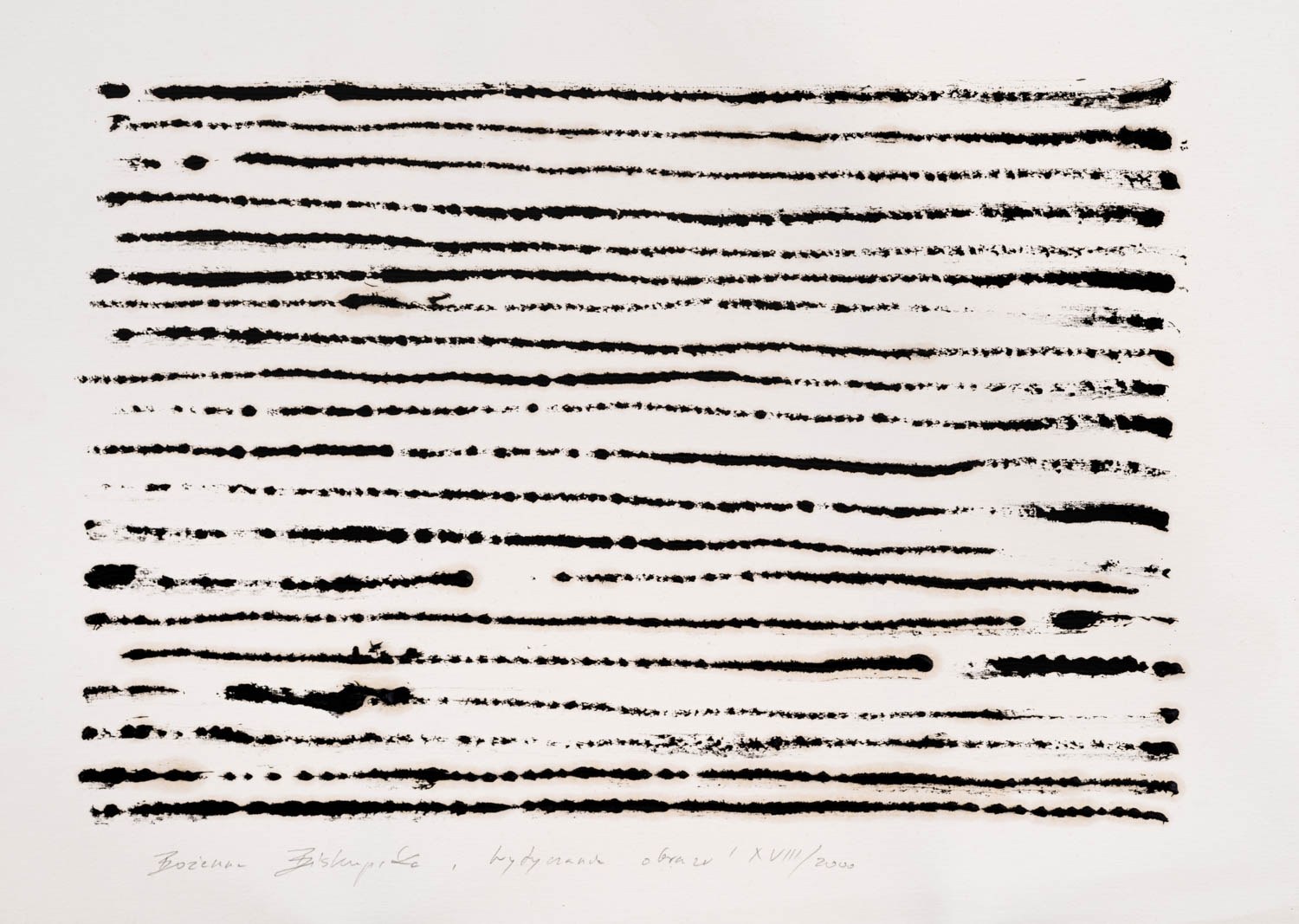
Wytyczanie obrazu XVIII

Wytyczanie obrazu K-14

Marking Out the Image

Marking Out the Image

Figure in Confinement I

Sculpture Drawing IV

Cage I

Sculpture Drawing II
Cut Cage

Line IV, from the series: Marking Out the Image

VI FROM THE SERIES: DESCRIPTION OF A HOUSE

Great Cage II

Marking Out the Image III

Cage VI

Cage IV
Non omnis moriar - Grandmother XI

The One-legged Man

Cage I

Figure III (in Confinement)

FIGURES, FROM THE SERIES: CAGE

Aquarium I / 0661

Great Cage 16

Marking Out the Image 8

Cage Filled with Matter

Great Cage VIII
Marking Out the Image 343
Biografia
Line, sign and trace: from this personal alphabet Bożenna Biskupska builds a story about time. From the 32 cocoon-sculptures of “The Mystery of Time”, with which she represented Poland at the 1984 Venice Biennale, to the immersive “Possible Building”.
Bożenna Biskupska (b. 1952) studied painting at the State Higher School of Fine Arts in Poznań and at the Academy of Fine Arts in Warsaw. From the outset she has moved freely between painting, sculpture, installation, video and performance, and her path leads from figurative art, through abstract forms, to her own elaborate language: the multi-threaded cycle “Marking Out the Image”.
The leading subject of her art is the passage of time, together with the annexing, organising and marking out of space. Line, sign and trace dominate Biskupska's personal alphabet. The artist experiments with sculptural-painterly matter (concrete, negative film, linseed oil) and reaches for new technologies, which allow her to transform space into the immersive “Possible Building”.
As early as 1984 she represented Poland at the 41st Venice Biennale, showing “The Mystery of Time”, a group of 32 anthropomorphic sculptures, close to the form of a sarcophagus and a cocoon, a symbol of existence stretched between duration and passing. That same year she received the first-degree Stanisław Wyspiański Award and first prize at the International Biennial of Tapestry Miniatures in Szombathely.
Since 2004, together with Zygmunt Rytka and her daughter Zuzanna Fogtt, she has run the In Situ Foundation for Contemporary Art, whose work is the rebuilding of the nineteenth-century sanatorium of Dr Brehmer in Sokołowsko and the creation within it of an International Laboratory of Culture. This neo-Gothic edifice was the model for the spa in Davos in Thomas Mann's “The Magic Mountain” and the setting of Olga Tokarczuk's “The Empusium”. In Biskupska's hands the ruin becomes a living “Possible Building”.
Her oeuvre runs from tapestry, through sculpture and systems, to installation and new media. In parallel she develops the cycles “The Cage” (for forty years now), “Drawing of Sculpture”, “Marking Out the Image” and the wire “Container Sculptures” with the iconic figure of the “One-Legged Man”. Biskupska's works are held, among others, at the Museum of Art in Łódź, the Auschwitz-Birkenau State Museum, the national museums in Gdańsk, Szczecin and Kielce, as well as in the collections of the Humboldt University of Berlin and the Polish Museum of America in Chicago.
In 2018 she received the Jerzy Stajuda Art Critics' Award, and in 2024 the National Museum in Wrocław devoted to her the retrospective “The Artist and the Possible Building”, the next, after Ewa Kuryluk and Magdalena Abakanowicz, monographic exhibition of an outstanding Polish woman artist in the Four Domes Pavilion. After half a century of a consistent, singular path, the work of Bożenna Biskupska is now entering fully into the canon of Polish contemporary art.
Wystawy
Solo exhibitions
- 2025
Cabinet of Possibilities
Międzynarodowe Laboratorium Kultury
Sokołowsko
- 2024
The Artist and the Possible Building (retrospective)
Pawilon Czterech Kopuł, Muzeum Narodowe
Wrocław
- 2024
In the Footsteps of the One-Legged Man →
Galeria Wallspace
Warsaw
- 2024
Container Sculptures
Centrum Rzeźby Polskiej
Orońsko
- 2003
Forms
Centrum Rzeźby Polskiej
Orońsko
- 2002
Królikarnia, Muzeum Rzeźby im. X. Dunikowskiego
Warsaw
Group exhibitions
- 2025
Triennial of Artists’ Books
Muzeum Sztuki Nowoczesnej
Olomouc, Czech Republic
- 2009
SIEGesIKONen / Icons of Victory – transFORM
Berlin, Germany
- 2000
NordArt
Büdelsdorf, Germany
- 1995
A Woman’s View
World Bank
Washington, D.C., USA
- 1986
14th International Biennial of Small Bronze Sculpture
Padua, Italy
- 1984
41st Art Biennale
Venice, Italy