Artysta
Maria Papa
Wybrane prace

Biografia
She carved marble herself. In a world where sculptors handed the stone over to craftsmen, Maria Papa Rostkowska handed over nothing.
Maria Papa Rostkowska was born in 1923 in Brwinów near Warsaw. During the Warsaw Uprising she served as a courier, carrying weapons through the sewers between the districts of the besieged city. Arrested and deported, she escaped from the transport to Auschwitz. For her part in the armed resistance she was decorated with the Silver Cross of the Virtuti Militari.
After the war she studied at the Academy of Fine Arts in Warsaw, and then, thanks to a scholarship, in Paris. She taught painting in Sopot and Warsaw. In 1957 she left Poland for good. A year later she married Gualtieri di San Lazzaro, an Italian critic and publisher of the journal XXe Siècle, the central platform of the New School of Paris, and entered a milieu in which her artistic neighbours were Miró, Chagall, Fontana, Hartung, Soulages and Szapocznikow.
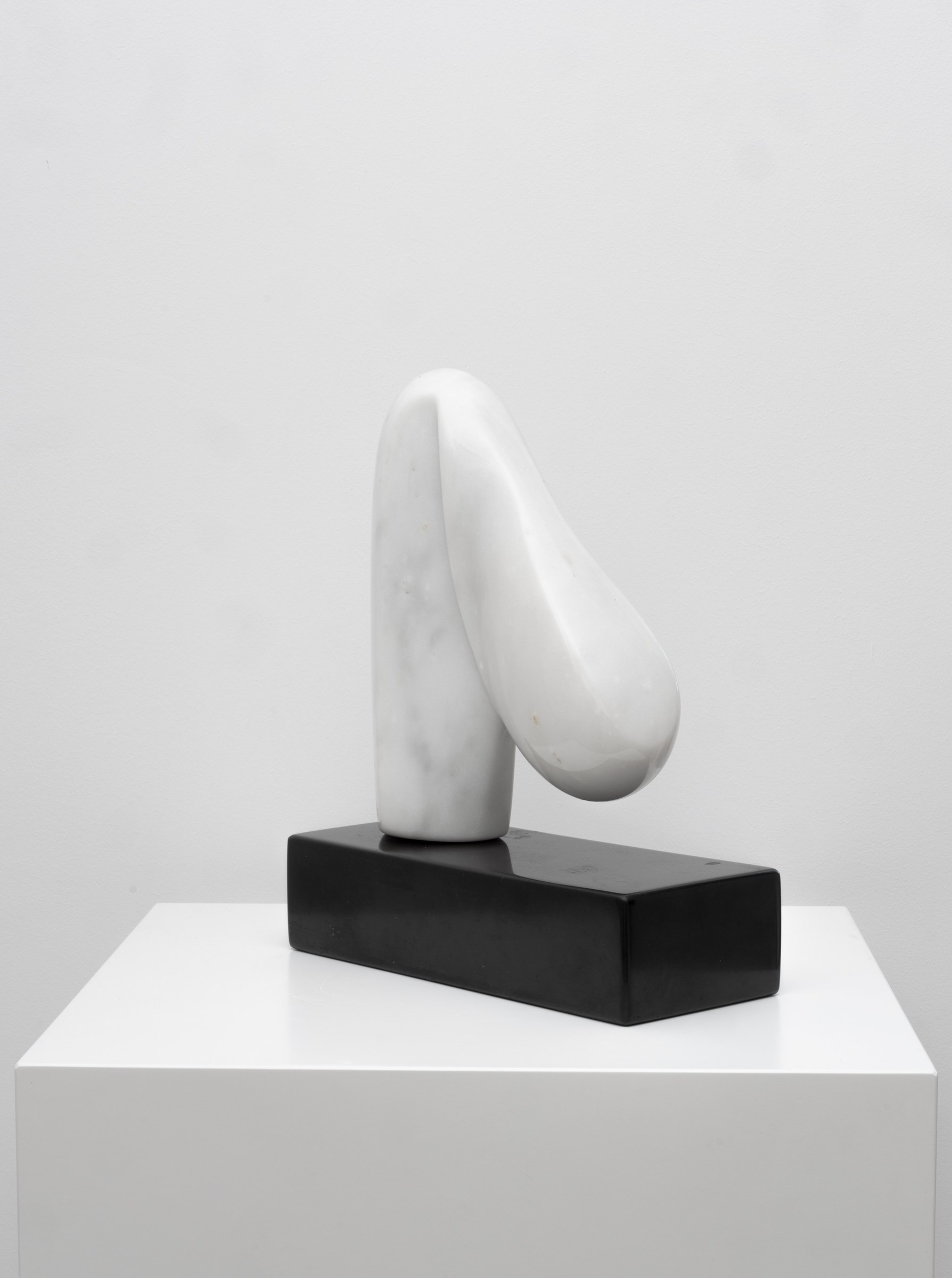
In Albisola she discovered sculpture through working in clay. In the mid-1960s, at the urging of Arp and Marino Marini, she turned to carving directly in marble. This technique, for most of the twentieth century reserved de facto for men, she made the foundation of her practice. She worked the stone in person, without the mediation of craftsmen. At the Henraux works in Querceta, where Henry Moore and Lipchitz sculpted, the workers called her Maria la Polacca.
In 1966 she was one of two Polish artists (alongside Alina Szapocznikow) to receive the Copley Foundation award. That same year she set up a studio in Pietrasanta, near the Carrara quarries. She created more than three hundred sculptures: from intimate works to monumental commissions in the public space of Paris and Warsaw.
Rostkowska's work, formally abstract, in content rooted in the themes of motherhood, combativeness and eros, sits at the intersection of classical sculpture and post-war modernity. Unlike her contemporaries exploring new synthetic materials, she remained faithful to marble as a material both ancient and radically physical: demanding, unpredictable, irreversible.
In Poland she showed her work for the first time after emigrating only in 1991. Her first national retrospective took place in 2014. Her oeuvre belongs to the most important and least recognised chapters of Polish sculpture of the second half of the twentieth century.