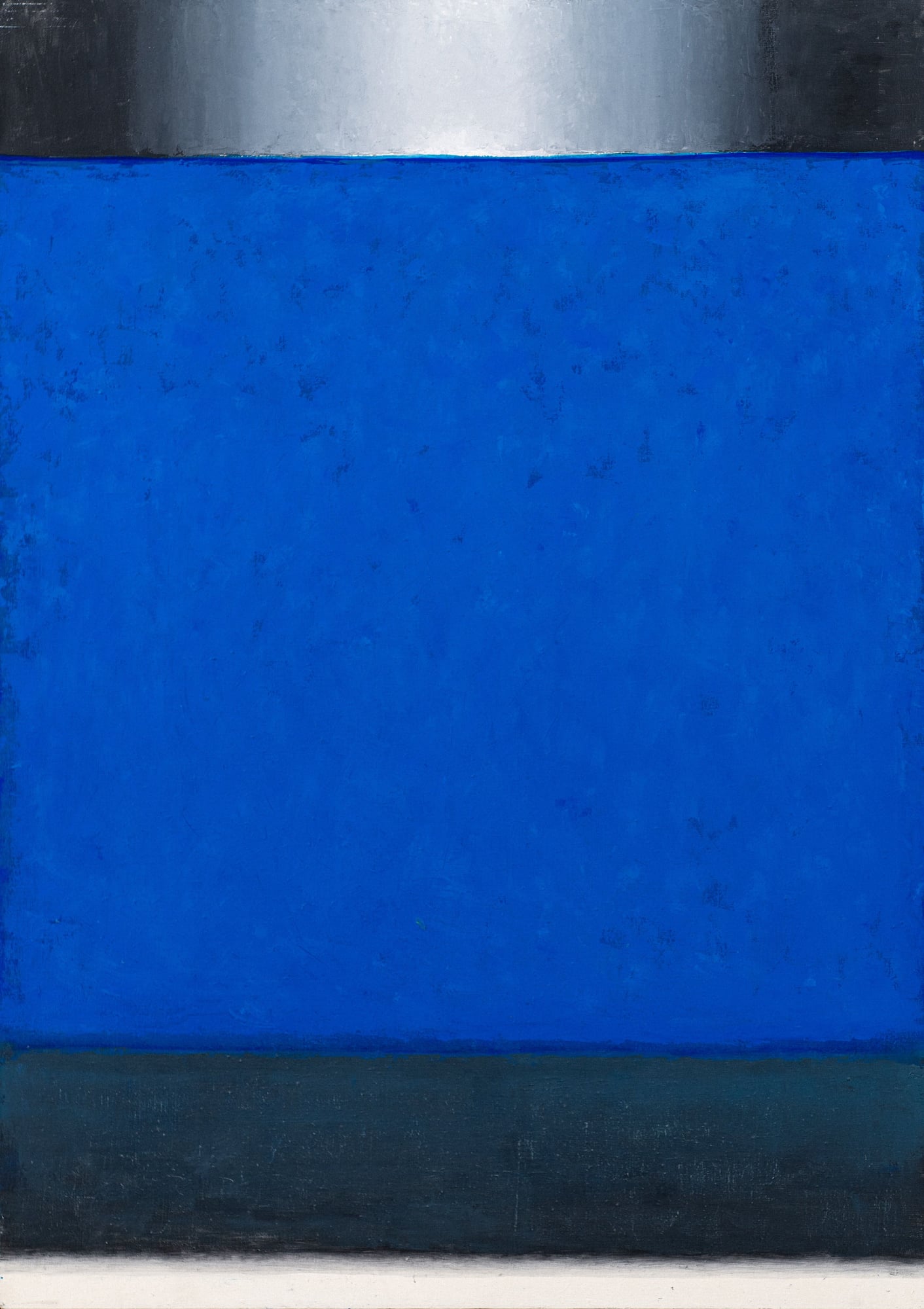
Painting DCCLXXIV
Non-objective art, as Stefan Gierowski himself called his work, is in his interpretation based on the action of colour, which is to act directly on the viewer. Other important elements he also explores are space, line and light. From the 1950s Stefan Gierowski has created a series of numbered paintings made exclusively in oil on canvas; the first of them arose in 1957. In an interview given to Jacek Michalak and Marta Skłodowska the artist states that he has painted about 1,000 paintings, considerably fewer than, for example, Stanisław Fijałkowski, who claimed to have created about 1,600 canvases. This small number of numbered works testifies to Stefan Gierowski's deliberation, contemplation and research approach to the field of art he practises. Stefan Gierowski ascribes emotional values to colours - that is, he holds that specific colours trigger corresponding feelings. At the same time he ascribes symbolic meanings to colours. The painter studied the physical features of colour using scholarly works in the fields of physics and optics, and on colour. His reading on the subject led him to several conclusions concerning colours. The first is the fact that the seeing of colour may in principle involve an error resulting from the eye's lack of sensitivity to, say, tones and shades (so-called colour blindness), or simply from personal preferences. The symbolic meaning of colours, on the other hand, is not uniform on account of the non-homogeneous cultural code. The last important element of seeing colour is the way the artist uses it - the intensity of the colour or its glaze-like quality, the structure of the applied paint, its juxtaposition with other tones and their mutual interaction. In Stefan Gierowski's case the structural experiments - described by him as a uniform gesture of the artist - were a deliberate intention arising from the desire to find an answer to successive questions of „what will happen if…”. At the moment when line enters the space of Gierowski's paintings, another aspect of his canvases also appears - space and a certain energy charge that it contains. According to the artist himself, even a straight line can introduce disquiet into a composition, not to mention the very fact that it is ultimately not objectively straight. According to the artist, a line dividing the canvas violates the image. It changes its space and at the same time influences another aspect important for the painter - the light in the painting, its luminosity. The light in the painter's paintings, in his opinion, is the most recognisable feature of his works, of which he says: „That is why the recognisability of my paintings does not result from any drawing coherent to them, but rather from what happens with the light that is born of the colours. For colour makes sense when it gives light. And what is more, what is most important, and what is now often forgotten, is that good paintings - both old paintings and contemporary paintings, abstract paintings and non-abstract paintings - all stand out in this, that light comes from them. It comes from them, and is not cast onto them to give a reflection. The reflection arises from the paint itself.” Despite the formal diversity that Stefan Gierowski's works take on, there is in them a logical sequence of reflection. His canvases constitute a monumental life's work, like the counted paintings of Roman Opałka, but they are not planned with such a mathematical strategy. Stefan Gierowski graduated from the Kraków Academy of Fine Arts. From 1949 he lived in Warsaw. In 1956-1961 he collaborated with the Krzywe Koło gallery run by Marian Bogusz. In 1992-1996 he was a teacher at the Warsaw academy, where in the second half of the 1970s he held the office of dean of the Faculty of Painting. In 1986 he received the title of full professor. In 1980 he was honoured with the Jan Cybis Award. In 1981 he was a member of the Organising Committee of the Congress of Polish Culture.
Zapytaj o pracę
Skontaktuj się z nami, aby dowiedzieć się więcej o dostępności i cenie tej pracy.
✓ Dziękujemy — odezwiemy się w ciągu 24 godzin.